 Wiring diagrams for a Denver Furnace |
* Updated February 13, 2010 *
Start Page | Navigation Page | Glass Discussion Board
DISCLAIMER: The information on this page is in no way meant to be comprehensive, and should NOT be taken as gospel. If you are not intimately familiar with wiring glass furnaces and/or other high voltage equipment you should NOT be wiring a glass furnace. Even if you ARE experienced with wiring glass furnaces, you should double check everything here, as there may be inadvertent errors in the information.
Basically what the above means is that if you choose to use this information for anything but its curiosity value, you are completely on your own. Neither the owner of this website, nor any contributors to the information on the page are liable for any injuries, damages, or other problems caused by the use of the information.
High voltage electricity can injure or kill you. Faulty wiring can cause fires and property damage, and injure or kill you.
DO NOT use this information to wire a glass furnace unless you know EXACTLY what you are doing! Clear enough?
With the above disclaimer out of the way, here are some wiring diagrams and other information for a Denver 135lb furnace kindly provided by Paul Weston. My own comment on the problem he mentions about a chattering MDR (mercury displacement relay) would be to check the cycle time of your controller if you have this issue, whether on a Denver furnace or any other electric furnace or annealer. Your controller's cycle time may be set too short and thereby cause the relay to chatter and ultimately fail prematurely. Twenty seconds is a reasonable cycle time for an MDR. Thirty seconds or more is better for an electro-mechanical relay. The problem with the longer times is that they can shorten the life of wire elements, especially on a glass furnace, which is why changing over to solid state control such as an SSR or SCR can be a good idea. But either way, Paul's suggestion of adding an MOV (metal oxide varistor) to a circuit that uses an MDR or electro-mechanical relay is a good one, and will help prevent voltage spikes from messing things up.
From here down all of the information is courtesy of Paul Weston.
DENVER FURNACE RELAY CHATTER
The Denver furnaces all seem to suffer from chattering mercury relays, e.g., they don’t switch on/off cleanly, they tend to go on and off in series of rapid operations. This greatly shortens the life of the relays with all the extra operations, and can cause more rapid deterioration of the internal contacts. The problem is caused by the controller picking up voltage spikes (surges) from the switching of the relay coil, and from induced current spikes from the switching of the large element current. When the relay coil is de-energised by the controller, it makes a spike of voltage, which in turn gets back into the controller via the 120 v wiring, and turns it back on again. This occurs rapidly several times until the controller finally wins and gets the relays opened.
The cure is simple. Just isolate the control wiring from the element and relay wiring, and install MOV surge suppressors. These little fellows become a short circuit when the voltage exceeds 150 v, so that they “swallow” any voltage spikes that can disturb the controller. Sometimes, in real stubborn cases, it may be necessary to add a ferrite choke around the 120v leads the power the controller. The drawings below show how it is done.


ELEMENT CONNECTORS
The connectors that Denver uses to connect the wires to the elements are somewhat pathetic and don’t last long. They don’t have enough mass to dissipate the heat from the element leads, so they loosen and burn in a short time. We have used bronze split-bolt connectors, as used by electricians and electric utilities. They are somewhat expensive, around $6 each retail, but they do not fail. We bought ours from the local electrical supply house, and they have been in service for about three years now, and been through several element changes.
The other problem with the connectors is that the use of flexible wire means that the connectors will not stay tight for extended periods of time. They do need checking every 2 or 3 months, if you elements last that long. If they become blackened, don’t worry, just file smooth any burns, soak them in vinegar for 30 mins or so, rinse off thoroughly, brush clean and re-use.
When installing new elements, make sure the mullite tubes extend from the element right out to within one inch of the end of the element connection rod. This stops the connectors from shorting to the furnace walls as the elements creep about.
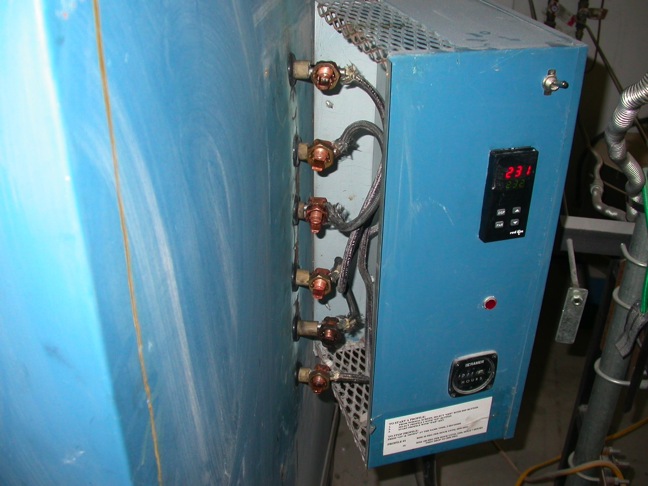
DENVER FURNACE ELEMENT CONNECTIONS